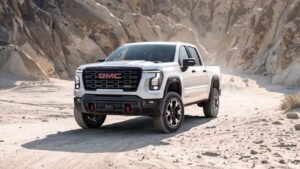
Some vehicles are designed for comfortable city driving, while others are built for one simple purpose: going where ordinary vehicles cannot. The extreme 4×4 shown here looks like it belongs to the second category. With massive off-road tires, a raised suspension, aggressive front protection and a rugged adventure-ready design, this machine looks ready to attack rocky trails, steep mountain roads and challenging terrain.
The combination of power, ground clearance, traction and durability is what makes an extreme 4×4 so impressive. It is not just about driving fast. It is about maintaining control when the road disappears completely.
A 4×4 Designed for Extreme Adventure
At first glance, this off-road machine immediately stands out from a normal SUV. The high ground clearance, wide tires, protective front bumper and roof-mounted equipment give it the appearance of a vehicle built for serious adventure.
The front end is particularly aggressive. The large round headlights, reinforced bumper and exposed recovery equipment create a tough appearance while also serving practical purposes on difficult trails.
For an off-road vehicle, appearance is not everything. Every major component needs to work together. Suspension, tires, drivetrain, approach angle, departure angle and underbody protection all play important roles when a vehicle is climbing over rocks or descending steep slopes.
Engine Power and Performance
When people see a 4×4 like this, one of the first questions they ask is: How fast is it?
The answer depends heavily on the exact engine, transmission, gearing and modifications used on the vehicle. An off-road build is generally not created simply to achieve the highest possible top speed. Instead, its performance is focused on producing useful power and torque at low speeds.
Low-speed torque is extremely important when climbing steep surfaces. The vehicle needs enough force to move its large tires over rocks, mud and uneven ground without constantly spinning the wheels.
A modified 4×4 can also have different engine options depending on its original model. Petrol and diesel engines can provide different combinations of horsepower, torque, fuel economy and response. Performance modifications may include engine tuning, upgraded exhaust systems, improved air intake and drivetrain changes.
So while its top speed may not be the most important specification, its ability to deliver controlled power in difficult conditions is what makes this type of vehicle special.
How Fast Can This Off-Road Beast Go?
Speed is an interesting part of any 4×4 discussion, but extreme off-road driving requires a different definition of performance.
On a normal road, drivers may care about 0–60 mph acceleration and maximum speed. On a mountain trail, those numbers become much less important. A successful off-road vehicle needs to move slowly and carefully when the terrain becomes dangerous.
The actual top speed of the vehicle shown in the image cannot be confirmed from the photograph alone because the exact model and engine specification are not provided. However, large off-road tires, suspension modifications and aggressive gearing are usually selected for trail performance rather than maximum highway speed.
In other words, this is a machine designed to conquer terrain, not race on a straight road.
Massive Off-Road Tires
One of the most noticeable features of this 4×4 is its huge tires.
Off-road tires are one of the most important upgrades for serious trail driving. Their large tread blocks can help provide traction on loose dirt, mud, gravel and rocky surfaces.
The tires also provide additional sidewall protection when driving over sharp rocks. A strong sidewall can be particularly valuable when the vehicle is carrying significant weight and operating far away from paved roads.
The wheels shown on this build also have an aggressive appearance that matches the rest of the vehicle. However, tire size should always be selected carefully because larger tires can affect steering, braking, acceleration, gearing and fuel consumption.
High Ground Clearance
Ground clearance is another major advantage of an extreme 4×4.
Imagine driving over a large rock with the underside of a normal car. The vehicle could easily become stuck or suffer expensive damage. A high-riding off-road vehicle has much more space between the ground and its vulnerable components.
The raised suspension shown in the image gives this vehicle a commanding stance. More clearance allows the tires to climb over obstacles while reducing the chance of the chassis hitting the ground.
However, increased ride height can also change the vehicle’s center of gravity. That means a properly engineered suspension system is essential for maintaining stability.
Suspension Built for Rough Terrain
A serious off-road vehicle needs more than big tires. It needs suspension capable of handling uneven surfaces.
On rocky trails, each wheel may encounter a completely different surface. One tire could be climbing a rock while another is sitting in a deep hole.
Good suspension helps keep the tires connected to the ground. This improves traction and allows the vehicle to maintain better control.
Off-road builds may use upgraded shocks, springs, control arms and other suspension components. The exact setup depends on the vehicle and the type of terrain it is intended to tackle.
For mountain trails, suspension travel can be just as important as engine power.
Four-Wheel Drive and Traction
The heart of any serious 4×4 is its four-wheel-drive system.
Instead of sending power only to two wheels, a four-wheel-drive system can distribute engine power across all four wheels. This can dramatically improve traction when surfaces become slippery or uneven.
Some advanced 4×4 systems also offer low-range gearing. Low range reduces vehicle speed while increasing the amount of usable torque delivered to the wheels.
That is exactly what a driver needs when crawling up a steep rocky trail.
Rather than accelerating quickly, the vehicle can move slowly and deliberately, allowing the driver to carefully choose a line through the obstacles.
Aggressive Front Bumper and Protection
The front bumper on this vehicle gives it an unmistakable adventure-machine appearance.
A strong aftermarket bumper can provide additional protection during off-road driving. It can also provide mounting points for recovery equipment, auxiliary lights or other accessories.
The vehicle appears to have recovery equipment at the front, which can be extremely useful when traveling through remote areas.
Getting stuck is part of serious off-roading. Even an extremely capable vehicle can become trapped in mud, loose sand or an awkward rocky position. Recovery equipment can help get the vehicle moving again when used correctly and safely.
Lighting for Night Adventures
The bright round headlights are another visual highlight of this build.
Good lighting is extremely important when driving after sunset. Mountain trails can become difficult to see because of darkness, dust, fog and shadows.
Many off-road enthusiasts also install additional lighting, including LED light bars and auxiliary lamps. These can provide a wider field of illumination and help drivers identify obstacles.
However, auxiliary lighting should be used responsibly and adjusted correctly so it does not blind other road users.
Interior and Adventure Equipment
The exterior tells only part of the story.
An adventure-focused 4×4 may also feature practical interior equipment such as durable seats, rubberized floor protection, navigation equipment, communication devices and storage solutions.
For long-distance off-road trips, storage can be especially important. Drivers may need to carry recovery gear, tools, water, spare parts, food and camping equipment.
A roof rack can increase carrying capacity, although additional weight placed high on the vehicle can affect handling and fuel economy.
Fuel Economy
One area where extreme off-road builds usually cannot compete with small cars is fuel economy.
Large tires, increased weight, lifted suspension, aggressive tread patterns and powerful engines can all increase fuel consumption.
Off-road tires create more rolling resistance, while a heavier vehicle requires more energy to accelerate. Aerodynamic modifications and roof-mounted equipment can also increase resistance at highway speeds.
For an adventure vehicle, however, owners often accept higher fuel consumption in exchange for greater capability.
Can It Really Conquer Mountains?
The answer depends on the terrain, driver skill and exact mechanical setup.
A capable 4×4 can handle impressive obstacles, but no vehicle is unstoppable. Deep mud, extreme rock sections, steep slopes and dangerous weather can challenge even the best-built off-road machine.
The biggest advantage is the combination of four-wheel drive, suitable tires, ground clearance, suspension travel and controlled torque.
Driver experience is equally important. Knowing where to place the tires, when to use low range and how to approach an obstacle can make a huge difference.
Road Driving vs Off-Road Driving
This type of 4×4 can be exciting on the highway, but its real personality appears away from the pavement.
On smooth roads, the large tires and lifted suspension may make the ride different from a standard SUV. Steering response, braking and fuel consumption can also be affected by modifications.
Once the vehicle reaches a rocky trail, however, those same modifications can become major advantages.
That is why extreme 4×4 vehicles are best understood as specialized adventure machines.
Final Verdict
This mountain-conquering 4×4 is a perfect example of why off-road vehicles continue to attract adventure enthusiasts around the world.
Its aggressive styling, massive tires, raised suspension, protective equipment and four-wheel-drive capability create a vehicle that looks ready for almost any trail.
Its exact horsepower, engine, acceleration and top speed depend on the specific model and modifications, so those figures should not be assumed from the image alone. But one thing is clear: this machine was built with off-road capability in mind.
For people who love mountains, rocky trails, remote adventures and extreme driving, a vehicle like this represents freedom. It is not simply transportation from one destination to another. It is a tool for exploration.
And when the paved road ends and the real adventure begins, this is exactly where a serious 4×4 can show what it was built to do.