The Future of Flying Cars Is Here:
Introduction
For decades, flying cars have existed mainly in science fiction, futuristic movies, and the imagination of automotive enthusiasts. Today, however, the idea of combining the excitement of a super-car with the freedom of flight is becoming more realistic than ever. The futuristic vehicle shown in this concept combines an aggressive super-car design with advanced-looking flight technology, creating a machine that appears to belong to the next generation of transportation.
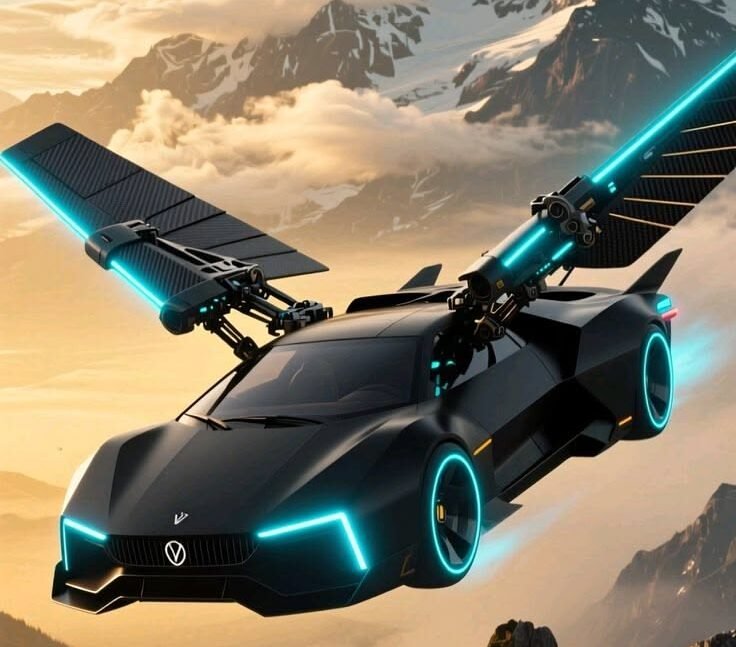
With its sharp aerodynamic body, glowing cyan lighting, large wheels, and wing-like structures, this futuristic flying super-car looks completely different from a conventional automobile. It represents a vision of what personal transportation could eventually become when automotive engineering, electric technology, aviation, and artificial intelligence come together.
Although this particular design should be viewed as a futuristic concept rather than a confirmed production vehicle, it gives us an exciting glimpse into what the future of flying cars could look like.
A New Era of Futuristic Transportation
The traditional automobile has changed dramatically over the last century. Cars have become faster, safer, more connected, and more efficient. Electric vehicles have also introduced a new generation of automotive technology.
The next major step could be taking transportation beyond the road.
A flying car concept could potentially allow people to travel through the air while maintaining some of the convenience and visual appeal of a personal automobile. Instead of being limited by traffic jams, mountain roads, or difficult terrain, future flying vehicles could theoretically use three-dimensional airspace to reach their destinations.
The futuristic super-car shown here takes that idea to an extreme. It combines the low, aggressive appearance of a high-performance vehicle with large wing-like structures that suggest vertical or assisted flight capabilities.
This combination creates a unique vision: a vehicle designed not only to dominate the road but also to explore the skies.

An Aggressive Supercargo Design
One of the first things that attracts attention is the vehicle’s dramatic exterior design.
The front end features an extremely low profile with sharp geometric lines. Instead of the rounded shapes commonly found on traditional cars, the concept uses angular surfaces to create a futuristic appearance.
The dark bodywork gives the vehicle a stealth-inspired personality, while bright cyan lighting around the headlights and wheels creates a high-tech visual identity.
The design also appears highly aerodynamic. A streamlined body could potentially help reduce air resistance, which is particularly important for any vehicle expected to travel at high speeds.
The wheels are equally striking. Their illuminated circular outlines make the vehicle look more like a machine from a futuristic video game than a conventional super-car.
Together, these elements create a powerful visual statement.
The Flying Technology Concept
The most interesting feature is obviously the aircraft-inspired system attached to the vehicle.
Large wing-like structures extend from both sides of the car. They appear to combine mechanical components, illuminated elements, and aerodynamic surfaces into one futuristic system.
In a real flying vehicle, engineering such a system would be extremely complicated. Designers would have to consider weight, stability, propulsion, battery capacity, aerodynamics, noise, safety, and control systems.
A successful flying car would need much more than an attractive design. It would require advanced flight-control technology capable of keeping the vehicle stable in different conditions.
Modern developments in electric propulsion, autonomous systems, lightweight materials, and computer-controlled flight are helping make concepts like this more imaginable.
However, turning a futuristic concept into a safe, practical, certified flying vehicle would remain a major engineering challenge.
Could Flying Cars Really Become a Reality?
The idea of flying cars is no longer purely fictional. Companies and research teams around the world have been investigating electric vertical takeoff and landing aircraft, commonly known as eVTOL aircraft.
These vehicles are designed to take off and land vertically and could eventually be used for passenger transportation, air taxis, emergency services, and other applications.
However, there is an important difference between an eVTOL aircraft and a flying super-car.
An eVTOL is primarily an aircraft designed for flight. A true flying car would ideally combine road-going capabilities with practical flight capabilities. That means engineers would need to solve two very different sets of problems within one vehicle.
The vehicle would need to function safely on roads while also meeting aviation requirements in the air.
That makes the flying-super-car concept one of the most ambitious ideas in future transportation.
Speed: More Than Just Performance
When people imagine a futuristic super-car, speed is usually one of the first things they think about.
A flying vehicle could potentially offer a completely different definition of speed. Instead of simply traveling faster on a highway, the biggest advantage could come from avoiding obstacles and choosing more direct routes through the air.
For example, a conventional car may need to follow roads around mountains, rivers, buildings, and other geographical barriers. A flying vehicle could potentially travel over these obstacles.
However, it would be incorrect to claim a specific top speed for this pictured concept because there are no verified production specifications associated with the image.
In the future, performance would depend on factors such as propulsion technology, vehicle weight, battery capacity, aerodynamic efficiency, and flight regulations.
The real revolution may therefore be less about achieving an extreme number on a speedometer and more about changing how people move from one location to another.
Electric Power and the Future
Electric propulsion could play an important role in the future of personal aerial transportation.
Electric motors can offer instant torque, compact packaging, and potentially lower local emissions than conventional combustion engines. These characteristics make electric propulsion attractive for both next-generation cars and aircraft.
The major challenge is energy storage.
Flying requires significant energy, and carrying batteries adds weight. Engineers therefore need to find a balance between battery capacity, vehicle mass, range, and performance.
Future improvements in battery technology could make electric flying vehicles more practical. New energy-storage technologies, lighter materials, improved motors, and more efficient propulsion systems could all contribute to longer flight times.
A futuristic super-car like this represents the ultimate goal: a stylish, powerful, technologically advanced vehicle that could potentially operate both on the ground and in the air.
Artificial Intelligence Could Change the Experience
Another important technology for future flying cars could be artificial intelligence.
Driving a conventional car already requires constant attention from the driver. Flying adds another layer of complexity because pilots must deal with altitude, weather, airspace, other aircraft, navigation, and changing environmental conditions.
Advanced computer systems could potentially assist with many of these tasks.
Future vehicles might use sensors, cameras, radar, GPS, and AI-based software to monitor their surroundings and help maintain safe flight paths.
Instead of manually controlling every aspect of the vehicle, passengers could eventually enter a destination and allow onboard systems to handle much of the navigation.
That vision is still developing, but autonomous technology is likely to become an important part of future transportation.
Luxury Meets Technology
The appeal of this futuristic concept is not only about transportation. It is also about luxury.
Traditional super cars are designed to provide an emotional experience through styling, performance, sound, and exclusivity. A flying super-car could take that philosophy into an entirely new dimension.
Imagine entering a vehicle with a futuristic cockpit, digital displays, intelligent navigation, premium materials, and advanced environmental controls. Instead of simply driving down a highway, the vehicle could potentially transition from road travel to aerial travel.
This would turn transportation into an experience.
The concept pictured here already communicates that feeling through its dramatic proportions, futuristic lighting, aggressive styling, and aviation-inspired design.
The Challenge of Safety
Despite the excitement surrounding flying cars, safety would be the most important consideration.
A flying vehicle operates in a much more complicated environment than a normal automobile. Mechanical failure, weather conditions, navigation errors, battery problems, and human mistakes could have serious consequences.
Future flying vehicles would therefore require extremely reliable systems.
Redundant motors, advanced flight-control computers, emergency landing systems, obstacle detection, weather monitoring, and highly reliable communication technology could all become essential.
Regulators would also need to establish new rules for operating personal aircraft in urban and rural environments.
The future of flying cars will ultimately depend not just on technology, but on whether these vehicles can be made safe enough for everyday use.
How Flying Cars Could Change Travel
If flying cars eventually become practical and affordable, they could have a major impact on transportation.
Daily commuting could change dramatically. People living far from major cities might be able to travel through the air instead of spending hours in traffic.
Emergency services could also benefit. Aerial vehicles could potentially reach locations that are difficult to access by road.
Tourism could become more exciting as travelers gain new ways to explore remote landscapes.
Mountainous regions, coastal areas, and other difficult-to-reach destinations could potentially become easier to access.
However, widespread adoption would also create challenges involving air traffic, infrastructure, noise, privacy, energy consumption, and environmental impact.
The future would require careful planning to ensure that flying vehicles improve transportation rather than creating a new set of problems.
From Science Fiction to Possible Reality
The biggest reason concepts like this attract so much attention is because they make the future easier to imagine.
For generations, flying cars were symbols of a distant future. Today, advances in electric propulsion, robotics, artificial intelligence, lightweight materials, and autonomous technology are bringing some parts of that vision closer to reality.
The futuristic super-car pictured here may be a concept rather than a commercially available vehicle, but its design represents an important question:
What if the automobile of tomorrow is not limited to the road?
That question is driving engineers, designers, technology companies, and automotive enthusiasts to rethink personal transportation.
Final Thoughts
The future of flying cars is still uncertain, but the idea has never been more fascinating.
This futuristic super-car combines the visual language of a high-performance automobile with the technology-inspired design of an aircraft. Its dramatic body, illuminated wheels, wing-like structures, and mountain setting create a powerful vision of tomorrow’s transportation.
There are still enormous challenges to overcome before flying cars become a normal part of everyday life. Battery technology, safety, regulations, infrastructure, affordability, and autonomous flight systems all need further development.
Nevertheless, the dream remains alive.
One day, the definition of a super-car may no longer be limited to horsepower, acceleration, and road speed. The ultimate performance vehicle could be one that gives drivers the freedom to travel both on the road and through the sky.
The flying super-car may still belong to the future—but concepts like this show just how exciting that future could be.
SEO Keywords
Primary Keywords: flying cars, futuristic flying car, flying super-car, future of flying cars, futuristic super-car
Secondary Keywords: future transportation, flying vehicle, electric flying car, futuristic car concept, luxury flying car, advanced transportation technology, future super-car, aerial vehicle, flying car technology
Meta Description
Discover the future of flying cars with this futuristic super-car concept combining advanced technology, luxury design, speed, electric innovation and the freedom of flight.